


In Switzerland, workplace cleanliness is not a matter of preference – it is a matter of law. Every employer operating in the country is bound by the Federal Labour Act (Arbeitsgesetz, ArG) and its implementing ordinances to maintain a clean, hygienic, and well-maintained working environment. The State Secretariat for Economic Affairs (SECO) oversees compliance at the federal level, supported by cantonal labour inspectorates that conduct regular workplace inspections.
Many Swiss employers – from small Zurich offices to large industrial facilities – are only partially aware of exactly what these obligations mean in practice. A vague understanding of 'keep the office clean' is not sufficient when a labour inspector arrives. Non-compliance with workplace hygiene standards under ArGV 3 can result in formal inspection findings, mandatory corrective orders, and, in serious cases, financial penalties.
This guide explains the legal framework clearly, identifies what SECO and cantonal inspectorates specifically look for, and shows how professional office cleaning in Zurich helps employers meet their compliance obligations reliably and efficiently.
Book Office Cleaning Zurich Now
The Swiss Legal Framework for Workplace Cleanliness
Swiss workplace health and safety law is built on a layered structure. Understanding which layer applies to which obligation is the starting point for compliance.
The Arbeitsgesetz (ArG) – Federal Labour Act
SR 822.11 – Federal Act of 13 March 1964 on Work in Industry, Commerce and Trade
The ArG is the primary federal statute governing occupational health and safety in Switzerland. Article 6 of the ArG establishes the foundational obligation: employers must take all measures necessary to protect the health and physical integrity of their workers. This duty of care is broad, non-delegable, and applies to all aspects of the work environment, including cleanliness and hygiene.
The ArG applies to virtually all commercial, industrial, and service-sector businesses operating in Switzerland. Key exemptions include federal and cantonal public administrations (governed by separate public law), agricultural enterprises, and private households. If your business employs staff in any commercial context, the ArG almost certainly applies to you.
Verordnung 3 zum Arbeitsgesetz (ArGV 3) – Ordinance 3 on Health Protection
SR 822.113 – Ordinance of 18 August 1993 on Health Protection under the Labour Act
ArGV 3 is the primary implementing ordinance for the health protection chapter of the ArG. It sets specific, enforceable requirements for the design, maintenance, and hygiene of workplaces. The cleaning and maintenance obligations most relevant to employers are concentrated in the following articles:
|
ArGV 3 Article |
Subject |
Core Requirement |
|
Art. 6 |
Structural condition of premises |
Floors, walls, and ceilings must be kept clean and maintained; surfaces must be easy to clean. |
|
Art. 11 |
Floors |
Floor surfaces must be smooth, non-slip, easy to clean, and resistant to the cleaning agents used. |
|
Art. 12 |
Walls and ceilings |
Must be light-coloured or reflective where possible; must be cleanable and maintained in good condition. |
|
Art. 13 |
Doors and windows |
Must be maintained and cleanable; window glass must allow sufficient daylight. |
|
Art. 17 |
Windows and lighting equipment |
Transparent and translucent surfaces (including windows) must be cleaned regularly. |
|
Art. 29 |
Social rooms (general) |
Changing rooms, washrooms, toilets, and rest areas must be kept clean and hygienic at all times. |
|
Art. 32 |
Toilets |
Must be sufficient in number, separated from workspaces, adequately ventilated, and kept clean |
|
Art. 33 |
Rest and eating areas |
Must be clean, hygienic, and maintained; separate from work areas in dusty or contaminated environments |
|
Art. 37 |
Maintenance and cleaning (core article) |
Workrooms and work equipment must be kept clean and in good working order; cleaning must not create health hazards during working hours. |
Art. 37 ArGV 3 (Instandhaltung und Reinigung) states explicitly: "Work rooms and work equipment shall be kept clean and in proper working condition." This provision is the legal backbone of the employer's cleaning obligation. The SECO guidance notes further specify that cleaning must be performed regularly, that cleaning methods must not endanger worker health (e.g., through chemical fumes), and that cleaning during working hours must not disturb work processes unnecessarily.
The Role of SECO and Cantonal Labour Inspectorates
SECO (Staatssekretariat für Wirtschaft) exercises federal oversight of the ArG and ArGV 3. It publishes detailed guidance documents (Wegleitungen) for each article of the ordinance, trains cantonal inspectors, and issues ordinances and policy directives.
Day-to-day enforcement is carried out by the cantonal Arbeitsinspektorate. In the canton of Zurich, this is the Amt für Wirtschaft und Arbeit (AWA). Inspectors conduct announced and unannounced workplace inspections, reviewing hygiene standards as part of a broader health and safety assessment. They have the legal authority to issue binding corrective orders and to report serious violations to prosecutorial authorities.
What a SECO or Cantonal Inspection Actually Checks
Understanding what inspectors look for in practice is essential for targeted compliance. Based on SECO guidance documents and published inspection criteria, the following areas are systematically assessed during a workplace hygiene inspection:
|
Inspection Area |
What Is Checked |
Common Non-Compliance Findings |
|
Workrooms (general) |
General cleanliness of floors, surfaces, and equipment |
Accumulated dust on surfaces; dirty floors; unhygienic shared equipment |
|
Windows and daylight sources |
Condition and cleanliness of window glass and frames |
Dirty windows reduce daylight levels below required standards |
|
Toilets and washrooms |
Hygiene standards, ventilation, supplies |
Insufficient cleaning frequency; absent soap/towels; poor ventilation |
|
Eating and rest areas |
Separation from work, cleanliness of surfaces and equipment |
Food contamination risks: unclean microwaves, fridges, or tables |
|
Waste management |
Waste bin placement, emptying frequency, and separation |
Overflowing bins; food waste left overnight; missing waste separation |
|
Air quality and ventilation |
Functioning of ventilation systems; odour and dust levels |
Blocked vents; persistent dust or chemical odour in workrooms |
|
Cleaning documentation |
Cleaning plans, schedules, and records |
No written cleaning schedule; no records of completed cleaning tasks |
|
Chemical safety (cleaning products) |
Storage and use of cleaning chemicals (Art. 24a ArGV 3) |
Improper storage; unmarked containers; lack of safety data sheets |
Practical insight: Inspectors do not require spotless perfection, but they do require evidence of a systematic, documented cleaning approach. An employer who can produce a cleaning plan, a cleaning schedule, and records of completed cleaning is demonstrably more compliant – and treated more favourably during inspections – than one who simply says cleaning is done regularly.
Cleaning Frequency Requirements by Workspace Type
ArGV 3 does not specify exact cleaning intervals in hours or days for most categories of space. Instead, the SECO Wegleitung to Art. 37 establishes the standard of 'as often as necessary to maintain cleanliness and hygiene.' In practice, this means the required frequency varies by the nature of the work and the contamination load of the space.
The following table reflects established best-practice interpretations of ArGV 3 requirements, consistent with SECO guidance and Swiss industry norms:
|
Workspace Type |
Minimum Recommended Frequency |
Legal Reference |
|
General office floors (vacuuming/mopping) |
Daily in high-traffic areas; 2–3x/week in low-traffic areas |
Art. 37 ArGV 3 |
|
Desk and surface cleaning |
Weekly; daily for shared workstations (hot-desking) |
Art. 24 + Art. 37 ArGV 3 |
|
Window glass (interior workspaces) |
Minimum 2x per year; more often where daylight reduction is noted |
Art. 13 + Art. 17 ArGV 3 |
|
Toilets and washrooms |
At least once daily; twice daily for high-use facilities |
Art. 32 ArGV 3 |
|
Eating areas and kitchens |
After each use (wipe-down), deep clean daily |
Art. 33 ArGV 3 |
|
Rest rooms and break areas |
Daily minimum |
Art. 29 + Art. 33 ArGV 3 |
|
Ventilation grilles and filters |
Quarterly inspection; clean/replace as needed |
Art. 18 ArGV 3 (ventilation) |
|
Waste bins |
Empty daily; disinfect weekly for food/organic waste |
Art. 37 ArGV 3 (general cleanliness) |
|
Deep cleaning (floors, walls, hard-to-reach areas) |
Minimum twice per year; quarterly in manufacturing/food |
Art. 37 + Art. 6 ArGV 3 |
Industry-specific note: Businesses in the food service, healthcare, pharmaceutical, and manufacturing sectors are subject to additional cleaning and hygiene standards from sector-specific legislation (e.g., the Lebensmittelgesetz for food businesses, cantonal health regulations for medical facilities). These requirements stack on top of the baseline ArGV 3 obligations and typically demand higher frequencies and documented HACCP-aligned cleaning protocols.
Employer Liability: What Happens When Standards Are Not Met
Failure to comply with ArGV 3 cleaning requirements is not merely an administrative inconvenience. The legal and operational consequences of sustained non-compliance include:
Labour Inspection Findings and Corrective Orders
A cantonal inspector who identifies hygiene deficiencies will issue a formal finding and set a deadline for correction. Persistent non-compliance after the deadline can escalate to mandatory administrative measures, which may include operating restrictions in severe cases.
Employee Health Claims and OR Liability
Under Article 328 of the Swiss Code of Obligations (OR), employers have a duty of care that encompasses the physical and psychological well-being of employees. An employee who develops a respiratory condition, a skin condition, or another health problem that can be attributed to inadequate workplace hygiene can bring a claim under Art. 328 OR. Swiss courts have upheld employee claims where poor cleaning practices contributed to documented health deterioration. This creates civil liability exposure for employers who neglect their cleaning obligations.
Accident Insurance and SUVA Implications
SUVA (Swiss National Accident Insurance Fund) conducts its own workplace safety inspections. A workplace found to be persistently unhygienic may trigger SUVA risk reclassification, potentially affecting premium rates. SUVA inspectors also cooperate with cantonal labour inspectorates, so a finding in one system can prompt inspection by the other.
Reputational and Operational Risk
Beyond legal liability, a visibly unclean workplace poses tangible business risks: reduced employee productivity and morale, negative impressions among clients visiting the premises, higher employee absenteeism linked to workplace-acquired illness, and difficulty attracting and retaining quality staff. In Zurich's competitive labour market, workplace quality – including hygiene – is an increasingly important factor in employer attractiveness.
Get a Free Office Cleaning Quote
Specific Provisions by Workplace Area
Offices and General Workrooms
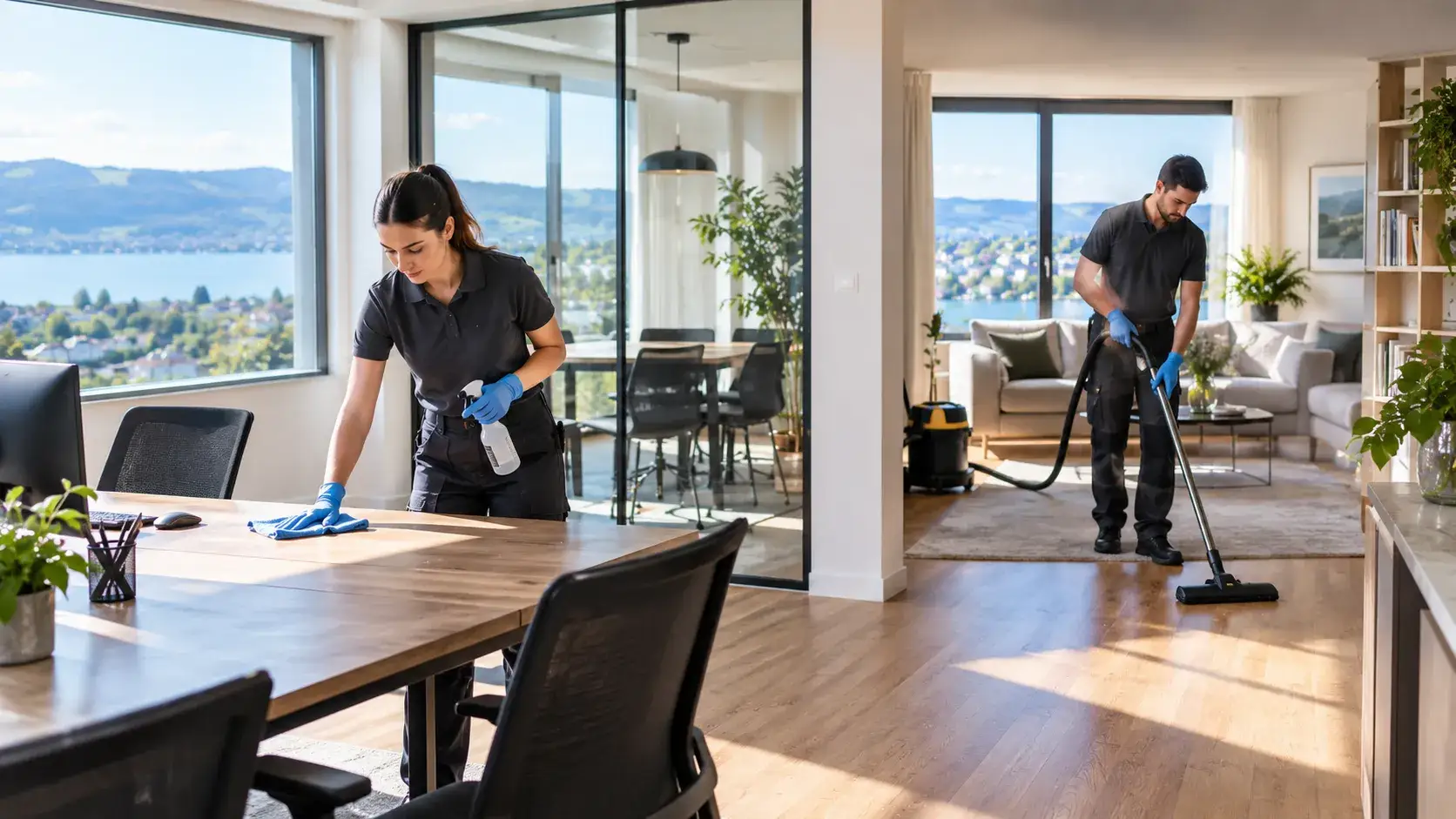
Under Art. 37 ArGV 3, all office areas must be kept clean and free from accumulated dust, dirt, and waste. Shared workstations require particular attention: under SECO guidance to Art. 24 ArGV 3, hot-desk environments must ensure each user encounters a hygienic workspace, which typically requires cleaning between users or at least daily cleaning of contact surfaces (keyboard, mouse, telephone handset, desk surface).
Windows and Natural Lighting
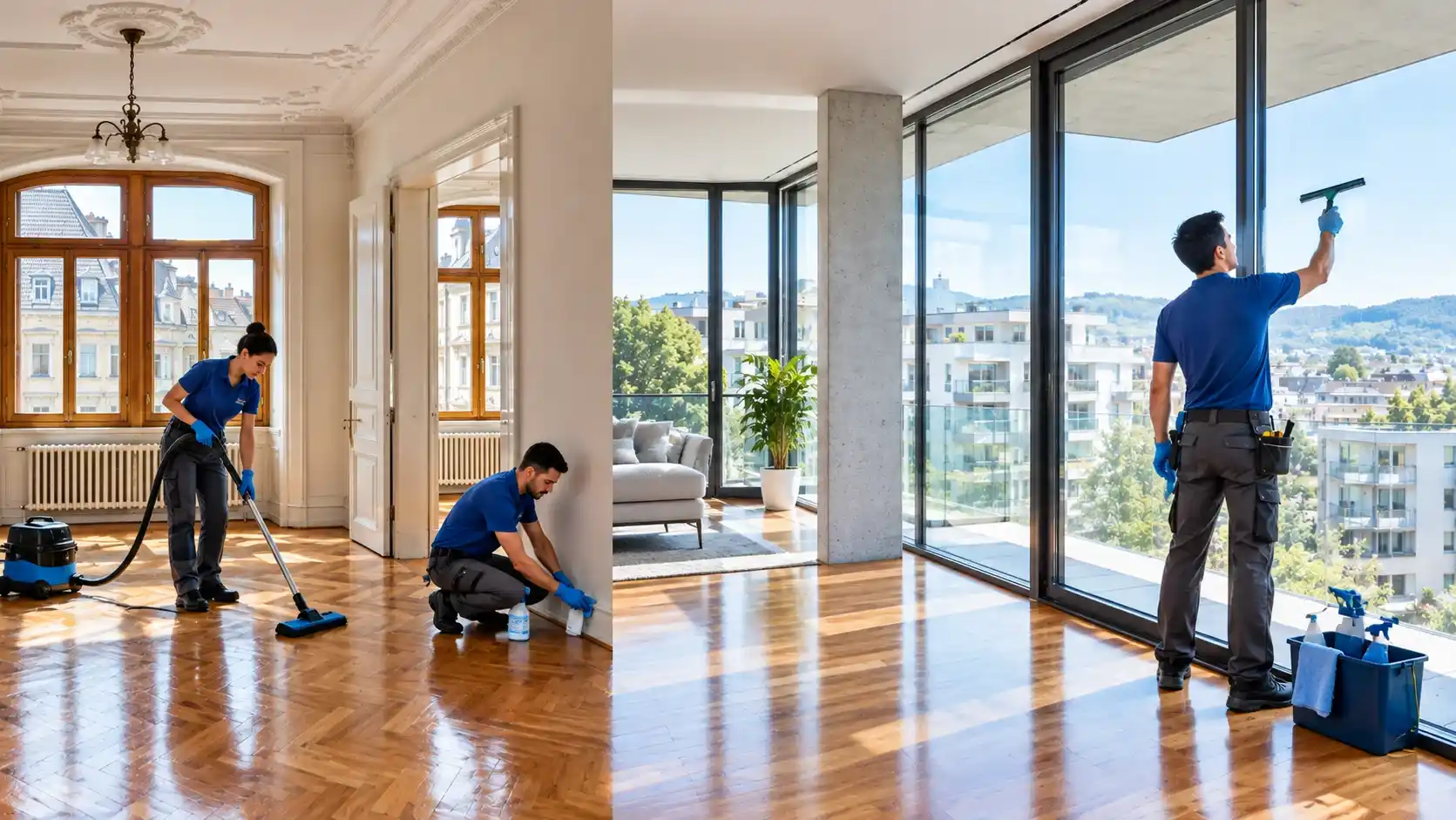
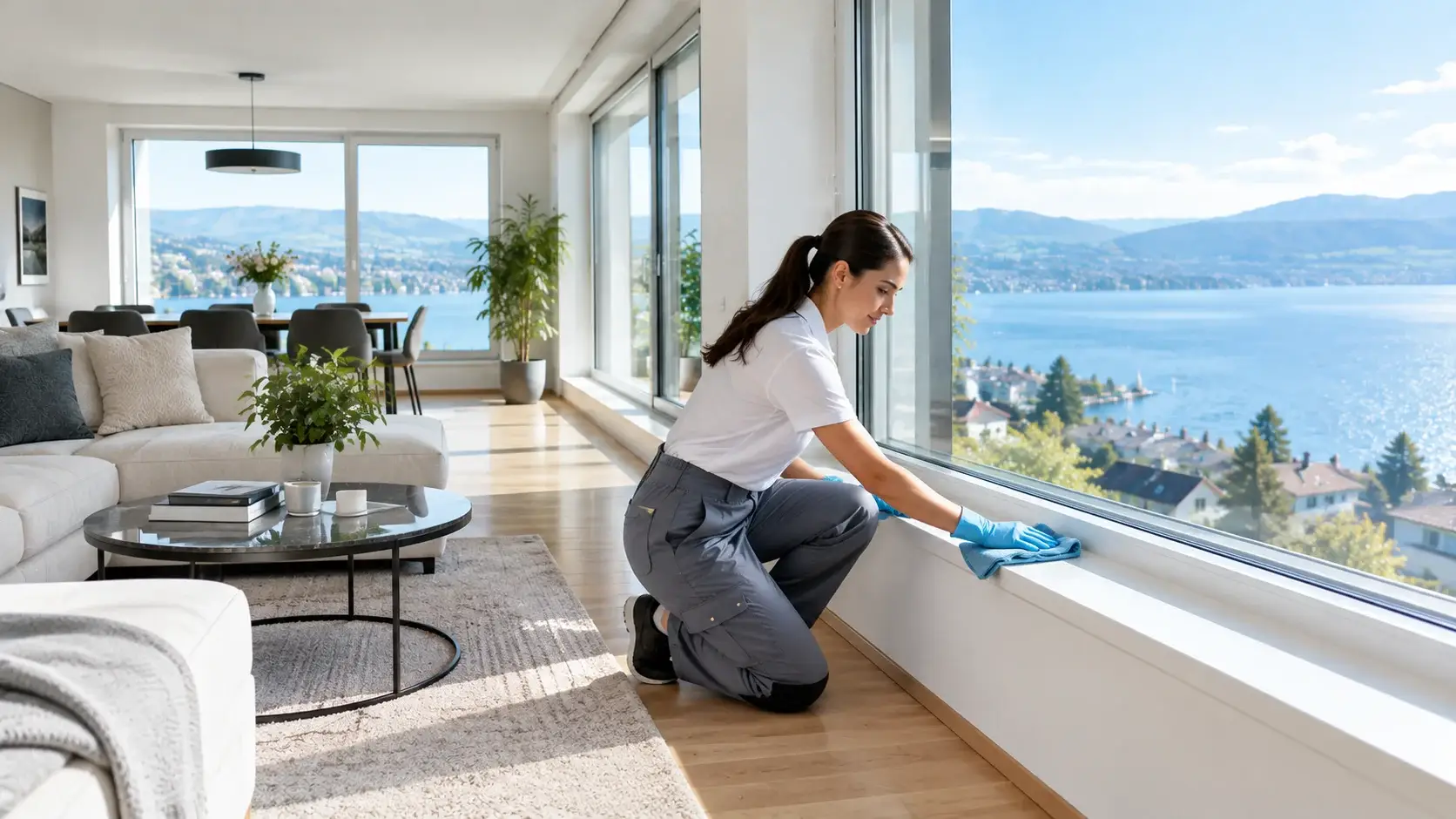
Articles 13 and 17 of ArGV 3 address windows and translucent surfaces as components of the required lighting standard. Dirty windows that materially reduce the natural daylight reaching workstations can constitute a violation of the lighting requirements. The SECO guidance specifies that window-cleaning frequency must be sufficient to maintain the required light levels. For most Swiss office environments, a minimum of twice-yearly professional window cleaning is regarded as the baseline, with more frequent cleaning required in urban locations where external soiling is higher.
Toilets and Washrooms
Art. 32 ArGV 3 establishes that toilets must be provided in sufficient numbers (with specific ratios by employee count), must be separated from workspaces by ventilated anterrooms, and must be adequately ventilated and kept clean. The SECO guidance makes clear that 'keeping clean' means regular cleaning – not merely the provision of cleaning supplies for employees to use themselves.
Eating Areas and Kitchens
Art. 33 ArGV 3 requires that eating and rest facilities be clean and hygienic. Where employees handle food or eat at work, surfaces, appliances (fridges, microwaves), and utensils must be kept clean. In workplaces where employees are exposed to dust, chemicals, or biological agents during their work, eating areas must be physically separated from work areas, and employees must be able to wash their hands before eating.
Social Rooms (Art. 29 ArGV 3)
The general provision for social rooms requires that all changing rooms, showers, washrooms, toilets, and rest facilities be kept in a hygienic condition. This means regular cleaning – not just structural adequacy – is a legal requirement. SECO guidance is explicit that the employer bears responsibility for the cleanliness of these facilities; delegating this to employees without providing adequate cleaning resources does not discharge the employer's legal duty.
Cleaning Documentation: Your Compliance Record
One of the most effective – and frequently overlooked – compliance measures is maintaining a written cleaning documentation system. Although ArGV 3 does not explicitly require cleaning records in all cases, inspectors consistently look for evidence that cleaning is systematic and not ad hoc. A cleaning log creates a defensible record that:
• Demonstrates that cleaning was performed at the required frequency
• Records which areas were cleaned, by whom, and with which products
• Identifies any incidents where cleaning was not completed and the reason
• Provides a basis for continuous improvement and scheduling adjustment
A professional cleaning company such as Züriclean provides this documentation as part of its standard service, giving employers a ready-made compliance record for inspection purposes.
In-House vs. Professional Office Cleaning: A Compliance Comparison
|
Compliance Factor |
In-House Cleaning |
Professional Cleaning (Züriclean) |
|
Legal knowledge |
Often limited – staff unaware of ArGV 3 standards |
Full awareness of ArGV 3 requirements and SECO guidance |
|
Consistency |
Variable – dependent on individual staff effort |
Contractually defined, consistent frequency and scope |
|
Documentation |
Rarely maintained in inspection-ready form |
Professional cleaning logs provided as standard |
|
Product safety (Art. 24a) |
Risk of inappropriate chemical use |
Correctly specified, safety data sheet-compliant products |
|
Window and deep cleaning |
Often skipped or infrequent |
Scheduled at required intervals as part of the service |
|
Inspection-readiness |
Low – hard to demonstrate a systematic approach |
High – documentation and schedule ready for inspection |
|
Liability reduction |
Limited |
Significant – transfers operational risk to a professional provider |
|
Cost transparency |
Hidden costs (staff time, products, training) |
Clear fixed pricing; no hidden overhead |
How Züriclean Supports Workplace Cleaning Compliance in Zurich
Züriclean provides professional office cleaning services to businesses of all sizes across Zurich, Zug, Lucerne, and Aargau. Our services are specifically structured to address the requirements of ArGV 3, including:
• Scheduled daily, weekly, and periodic cleaning: Tailored to the nature and intensity of your workplace, aligned with ArGV 3 frequency standards.
• Window and glass cleaning: Scheduled at frequencies that maintain natural light levels as required under Art. 13 and 17 ArGV 3.
• Toilet and washroom sanitisation: Daily cleaning of all sanitary facilities, with detailed attention to contact surfaces, ventilation, and supply maintenance.
• Kitchen and break area cleaning: Regular cleaning of all surfaces, appliances, and utensils in eating areas.
• Deep cleaning: Periodic comprehensive cleaning of floors, walls, and hard-to-reach areas as required under Art. 6 and 37 ArGV 3.
• Cleaning documentation: Written cleaning logs provided for every service visit, ready for presentation to labour inspectors.
• Eco-certified products: All cleaning products are EU Ecolabel-compliant and documented with safety data sheets, satisfying Art. 24a ArGV 3 chemical safety requirements.
We also offer deep cleaning, carpet cleaning, mattress cleaning, and apartment cleaning services across the region. Contact Züriclean for a free compliance-aligned cleaning quote for your business.
Practical Compliance Checklist for Swiss Employers
Use this checklist to assess your current compliance with ArGV 3 cleaning obligations:
|
Area |
Compliance Check |
Compliant? |
|
General workrooms |
Are floors cleaned daily (high-traffic) or 2–3x per week (low-traffic)? |
Y / N |
|
Shared workstations |
Are contact surfaces cleaned daily or between users? |
Y / N |
|
Windows |
Are windows cleaned at least twice yearly? More often, if daylight is reduced? |
Y / N |
|
Toilets |
Are toilets cleaned at least once daily? Twice daily for high-use? |
Y / N |
|
Eating areas |
Are kitchen surfaces and appliances cleaned daily? Eating areas after each use? |
Y / N |
|
Waste management |
Are bins emptied daily? Are food waste bins disinfected weekly? |
Y / N |
|
Ventilation |
Are ventilation grilles and filters inspected and cleaned quarterly? |
Y / N |
|
Cleaning documentation |
Is a written cleaning schedule maintained, and are records kept? |
Y / N |
|
Chemical safety |
Are cleaning products stored correctly, with safety data sheets available? |
Y / N |
|
Deep cleaning |
Is a deep clean of all areas performed at least twice per year? |
Y / N |
Conclusion: Compliance Is Not Optional – But It Can Be Simple
Swiss workplace cleaning law is specific, enforceable, and increasingly scrutinised by cantonal labour inspectorates. The ArG and ArGV 3 impose clear obligations on every employer: keep workrooms clean, maintain toilets and social areas in hygienic condition, clean windows sufficiently to maintain required light levels, document your cleaning practices, and ensure that chemicals used in cleaning are handled safely.
The good news is that compliance is entirely achievable with the right professional partner. A structured, documented cleaning programme from a qualified provider removes the guesswork from compliance, reduces employer liability, protects employee health, and ensures your business is ready for inspection at any time.
Discover how Züriclean's professional office cleaning service in Zurich can bring your workplace into full ArGV 3 compliance. Request a free quote at Zuriclean.
Frequently Asked Questions: Cleaning Compliance in Swiss Workplaces
1. Is an employer legally required to clean Swiss workplaces?
Yes. Article 6 of the ArG and Article 37 of ArGV 3 impose a clear legal duty on every Swiss employer subject to the Labour Act to keep workrooms and work equipment clean and in proper working order. This obligation cannot be delegated to employees without providing the necessary resources and supervision. Failure to meet this standard can result in formal inspection findings, corrective orders, and civil liability under Art. 328 of the Code of Obligations.
2. What does SECO inspect during a workplace hygiene inspection?
SECO and cantonal labour inspectors assess the general cleanliness of workrooms, the condition and cleanliness of toilets and washrooms, the hygiene of eating and rest areas, waste management practices, the condition of windows and ventilation systems, and the safe handling and storage of cleaning chemicals. Inspectors also look for evidence of a systematic, documented cleaning approach – a written cleaning schedule and cleaning records carry significant weight in an inspection.
3. How often must office windows be cleaned under Swiss law?
ArGV 3 does not specify an exact interval, but Articles 13 and 17 require that windows and other translucent surfaces are maintained so that required natural light levels reach workstations. For most Swiss offices, this means a minimum of twice-yearly professional window cleaning. In urban locations with higher soiling rates, quarterly cleaning is more appropriate. The standard is: as often as necessary to maintain required light levels.
4. Can employees be required to clean their own workplaces?
Employees can be asked to maintain basic tidiness of their personal workspaces, but the legal obligation for systematic workplace cleaning under ArGV 3 rests with the employer. The employer cannot discharge their legal duty simply by expecting staff to clean. They must ensure that adequate, competent cleaning is performed at the required frequency, whether by employed cleaning staff or by a contracted professional cleaning company.
5. Does professional office cleaning help with SECO compliance?
Yes, significantly. A professional cleaning company provides contractually guaranteed cleaning frequencies, documented cleaning logs for inspection purposes, correctly specified cleaning products with safety data sheets, and scheduled periodic and deep cleaning at intervals required by ArGV 3. Züriclean's office cleaning service in Zurich is designed specifically to support employer compliance with Swiss workplace hygiene law.

.webp)


.webp)


.webp)


_11zon.webp)


.webp)


