


Hiring a cleaning lady in Zurich seems like the simplest thing in the world. A neighbour recommends someone, you agree on a rate, and she comes every two weeks. Clean apartment, easy life.
Except that under Swiss law, you are now an employer, and Swiss employment law comes with real obligations even for a single domestic worker visiting your home for just a few hours a week. Most households discover this only when something goes wrong, such as an injury, a tax audit, or a visit from the social insurance authorities, and the penalties for non-compliance are very real. AHV back-contributions, interest charges, and employer liability for uninsured accidents are all significant risks. This guide explains what you are legally required to do when hiring a cleaning lady in Zurich, including how the AHV simplified procedure works, what insurance you need, what a contract should include, and why many households are now choosing regular cleaning services in Zurich instead of private arrangements to stay fully compliant with Swiss law.
Are You an Employer When You Hire a Private Cleaning Lady?
This is the first question every Zurich household needs to answer clearly. The answer depends on the legal status of the person you are hiring.
If She Is an Employee (Angestellte)
If the cleaner works exclusively or primarily for you, follows your instructions about how and when to clean, uses your equipment, and you decide her working hours, she is almost certainly classified as your employee under Swiss law — regardless of how much or how little she earns.
As the employer, you are responsible for registering with the relevant compensation fund (AHV/IV/EO), making social insurance contributions, taking out accident insurance, and in some cases contributing to supplementary pension insurance (BVG).
If She Is Self-Employed (Selbständigerwerbend)
A cleaner is genuinely self-employed if she works for multiple households, sets her own rates, brings her own equipment, and is registered as self-employed with the AHV compensation fund. In this case, she handles her own AHV contributions and insurance — and you have no employer obligations.
However, many people incorrectly assume their cleaner is self-employed to avoid obligations. Swiss authorities take this seriously. If the cleaner does not have a valid self-employment registration and you have been paying her without AHV compliance, you are exposed to back-payments and penalties.
Important: Always ask for written confirmation of your cleaner's self-employment status before assuming you have no employer obligations. A declaration alone is not sufficient — she must be registered with the AHV compensation fund as self-employed.
The AHV Obligation: What Swiss Household Employers Must Do
AHV (Alters- und Hinterlassenenversicherung) is Switzerland's state pension and social insurance system. All employees in Switzerland must be covered — including domestic workers.
The Standard AHV Procedure
Under the standard procedure, you as the household employer must: register with a cantonal AHV compensation fund, calculate and deduct the employee's share of contributions from wages, pay the employer's share on top, and report wages annually. This applies regardless of how many hours per week your cleaner works.
The Simplified Procedure (Vereinfachtes Abrechnungsverfahren)
For private household employers in Switzerland, there is a significantly easier option: the Vereinfachtes Abrechnungsverfahren (simplified settlement procedure), governed by Article 37a AHVG.
Under this procedure:
• You report wages to a single AHV compensation fund once a year.
• A flat rate of 5% of the gross wage is deducted from the employee's salary.
• You contribute a matching 5% as the employer.
• Total deduction from the wage bill: 10% (employee 5% + employer 5%).
• The procedure covers AHV, IV, EO, and ALV contributions in one simplified step.
• You do not need to calculate individual components separately.
The simplified procedure is available when the annual gross wage paid to the individual does not exceed CHF 22,050 (2025 threshold). Most part-time domestic workers fall comfortably within this limit.
Key Takeaway: The simplified procedure makes AHV compliance genuinely manageable for households. One annual declaration, a flat 10% contribution rate, and everything is covered. It takes approximately 30 minutes once a year.
|
AHV Procedure |
Eligibility |
Contribution Rate |
Administrative Effort |
|
Standard Procedure |
All employers |
AHV: 8.7%, IV: 1.4%, EO: 0.5%, ALV: 2.2% (employer+employee combined) |
Monthly reporting; quarterly payments; annual salary declaration |
|
Simplified Procedure |
Household employers; annual wage up to CHF 22,050 per person |
Flat 10% total (5% employee + 5% employer) |
Annual declaration only; single payment; no monthly reporting |
Accident Insurance: The Obligation Every Household Employer Misses
This is the legal obligation that most private employers in Zurich overlook — and it carries some of the most serious consequences. Under the Unfallversicherungsgesetz (UVG), every employee in Switzerland must be covered by compulsory accident insurance.
Occupational Accident Insurance (Berufsunfallversicherung — BU)
If your cleaner works 8 or more hours per week for you, you are required to provide occupational accident insurance as the employer. This covers injuries that happen while she is working at your home.
Non-Occupational Accident Insurance (Nichtberufsunfallversicherung — NBU)
If she works fewer than 8 hours per week for you, non-occupational accident insurance is her own responsibility — it is typically covered through her main employer if she has one. However, this only applies if she genuinely has another employment relationship.
What Happens Without Accident Insurance
If your cleaner slips on your wet bathroom floor and breaks her wrist while uninsured, you are personally liable for her medical costs, rehabilitation, and lost earnings. Swiss courts consistently enforce this. The financial exposure from a single serious accident can reach tens of thousands of francs.
Important: Do not assume accident insurance is optional. Even for a cleaner who visits just once a week, you need to verify the insurance situation clearly before the first day of work.
|
Situation |
Occupational Accident (BU) |
Non-Occupational Accident (NBU) |
Who Pays BU Premium |
|
Cleaner works 8+ hrs/week for you |
Your obligation as an employer |
Also your obligation |
Employer (you) |
|
The cleaner works under 8 hrs/week for you |
Your obligation as an employer |
Her responsibility (via main employer) |
Employer (you) |
|
Cleaner is self-employed (registered) |
Her own responsibility |
Her own responsibility |
Not applicable |
|
Agency cleaner (e.g., Züriclean) |
Agency's responsibility |
Agency's responsibility |
The agency handles it completely |
The Employment Contract: What It Must Include
Under Swiss law, employment contracts can be written or verbal for short-term arrangements. However, for any regular ongoing domestic employment, a written contract is strongly recommended and, for certain terms, legally required.
A proper employment contract for a domestic worker in Zurich should cover:
- Identity of both parties: Full names and addresses of employer and employee.
- Start date and type of contract: Fixed-term or open-ended employment relationship.
- Working hours: Specific days, start time, end time, and any flexibility provisions.
- Hourly wage or fixed monthly salary: Stated in CHF, specifying gross and net amounts.
- AHV deductions: Confirmation that AHV contributions will be deducted and paid through the simplified or standard procedure.
- Holiday entitlement: Minimum 4 weeks (20 working days) per year under Swiss law, pro-rated for part-time work.
- Notice period: Typically 1 month during the first year, 2 months from the second year onward.
- Sick pay provisions: Swiss law requires continued wage payment during illness; typical arrangements should be documented.
- Tasks and scope: A clear description of which rooms are cleaned, which tasks are included, and what is excluded.
- Confidentiality: Relevant for access to the home, personal items, and family information.
Key Takeaway: A written contract protects both parties. If a dispute arises about hours worked, tasks expected, or wages owed, a signed contract is the only reliable reference point.
BVG Pension Contributions: When Do They Apply?
The BVG (Berufliche Vorsorge / occupational pension) requirement applies when an employee's annual salary from a single employer exceeds CHF 22,050 (2025 entry threshold).
For most part-time domestic cleaners working a few hours per week, the annual wage from one household will fall below this threshold, and BVG contributions will not apply.
However, if you are the cleaner's primary employer and her annual salary with you exceeds CHF 22,050, you must register with a pension fund (Pensionskasse) and contribute accordingly. Both employer and employee share the BVG contribution, with the employer required to contribute at least 50% of the total premium.
The Real Cost of Private Hiring vs. a Professional Agency
Before deciding to hire privately, it is important to understand the full cost picture. The hourly wage is only one component.
|
Cost Component |
Hiring Privately (Direct) |
Booking Through Züriclean |
|
Hourly wage |
CHF 25-35/hour (market rate) |
Included in the agency rate |
|
AHV/IV/EO/ALV (employer share) |
~5% of gross wage (simplified procedure) |
Handled by the agency |
|
Accident insurance (BU) |
CHF 80-200/year (estimated) |
Handled by the agency |
|
Employment contract preparation |
Your time and responsibility |
Not needed |
|
Holiday pay provision |
+8.33% accrual on top of wages |
Handled by the agency |
|
Sick pay obligation |
Your liability during illness |
Handled by the agency |
|
Replacement cover if cleaner absent |
Your problem to solve |
The agency provides a replacement |
|
Annual AHV declaration |
Your responsibility |
Not needed |
|
Liability if cleaner injured |
Personal employer liability |
Fully insured by the agency |
|
Total effective cost per hour |
CHF 30-42/hour (when all obligations are included) |
Transparent fixed rate; no hidden obligations |
The cost gap between private hiring and agency booking is smaller than most people expect once all legal obligations are properly accounted for. And the administrative burden and liability exposure are removed entirely with a professional agency.
Key Takeaway: The 'cheap' private cleaner often costs more than an agency once AHV, accident insurance, holiday pay, and sick pay obligations are factored in — and without any of the legal compliance.
The Legal Risk of Informal Arrangements in Zurich
Many households in Zurich — particularly expats unfamiliar with Swiss employment law — operate informal cash-in-hand arrangements with a private cleaner. This is understandable, but it creates genuine legal and financial risk for the household employer.
Swiss social insurance authorities (AHV-Ausgleichskassen) have the right to audit household employers. They can:
• Request several years of wage records retrospectively.
• Demand full back-payment of AHV contributions (both employer and employee shares) for all unpaid years.
• Charge interest on outstanding amounts from the date contributions should have been made.
• Impose administrative penalties in cases of clear non-compliance.
In addition, if your uninsured cleaner is injured at your home, SUVA (the Swiss national accident insurance fund) can pursue the household employer directly for medical and rehabilitation costs.
This is not an area where the risk is small or theoretical. Swiss enforcement is consistent, and the financial exposure is meaningful.
Important: Paying a cleaner in cash without AHV registration is not a grey area in Switzerland. It is non-compliant with the mandatory social insurance law, regardless of whether both parties agreed informally.
Private Hiring vs. Professional Cleaning Agency: A Complete Comparison
|
Factor |
Hiring a Private Cleaning Lady |
Booking with Züriclean |
|
Legal employer status |
You are the employer |
No employer relationship |
|
AHV obligation |
Yes — simplified or standard procedure |
None — the agency handles all payroll |
|
Accident insurance |
Yes — your obligation under UVG |
None — fully insured by the agency |
|
Written contract required |
Yes — strongly recommended |
Not required (covered by agency contract) |
|
Holiday pay |
Yes — 4 weeks minimum by law |
Included in agency pricing |
|
Sick pay |
Yes — Swiss employment law applies |
Not your concern |
|
Replacement if absent |
Your responsibility is to arrange |
The agency provides a trained replacement |
|
Consistency of service |
Depends on individual |
Trained, standardised team |
|
Background and reference checks |
Your responsibility |
Conducted by the agency |
|
Cleaning products provided |
Usually not |
Eco-certified products included |
|
Booking and scheduling |
Direct communication |
Online booking available |
|
Tax and wage administration |
Your time and responsibility |
Zero admin for you |
|
Liability exposure |
Personal — significant risk |
Fully on the agency |
Why Many Zurich Households Are Choosing Professional Agencies
The trend in Zurich is clear: more and more households — particularly expats, dual-income families, and professionals — are choosing professional cleaning agencies over private arrangements. The reasons are not primarily about cost. They are about peace of mind.
• Zero legal exposure: When you book through a registered cleaning company, you have no employer obligations whatsoever. No AHV, no insurance, no contract, no sick pay liability.
• Reliability: If your regular cleaner is ill or unavailable, the agency sends a trained replacement. Your cleaning schedule never gets disrupted.
• Quality consistency: Professional companies train their staff, conduct quality checks, and maintain service standards that individual private arrangements rarely match.
• Insurance coverage: If anything is damaged or broken during a professional cleaning visit, the agency's liability insurance covers it. With a private cleaner, the situation is legally complicated.
• Eco-friendly products: Companies like Züriclean use certified, non-toxic cleaning products — safe for children, pets, and sensitive households — without you needing to research or purchase them yourself.
For households in Zurich looking for reliable regular cleaning services without the administrative burden of becoming an employer, Züriclean offers weekly, bi-weekly, and monthly cleaning plans with complete flexibility and full legal compliance baked in from day one.
Step-by-Step: Staying Legally Compliant if You Hire Privately
If you decide to proceed with hiring a private cleaning lady, here is the correct process to stay fully compliant:
- Confirm her employment status: Ask whether she is registered as self-employed with an AHV compensation fund. Request written confirmation. If she cannot provide this, she is likely an employee.
- Register as an employer: Contact your cantonal AHV compensation fund (Ausgleichskasse) and register as a household employer. In Zürich, this is the SVA Zürich (Sozialversicherungsanstalt des Kantons Zürich).
- Choose simplified or standard procedure: For annual wages under CHF 22,050 per person, the simplified procedure is the practical choice.
- Arrange accident insurance: Contact an insurance provider (e.g., Zurich Insurance, AXA, Helvetia) and take out occupational accident insurance (BU). If she works 8+ hours per week for you, this is mandatory from day one.
- Draft a written employment contract: Use the checklist from Section 4 of this article and have both parties sign it before work begins.
- Calculate and document wages: Keep clear records of every payment, including date, hours worked, gross wage, and AHV deductions. These records must be available for audit.
- Submit annual AHV declaration: Each year, submit the wage declaration to your AHV compensation fund and make the total contribution payment.
- Review BVG threshold annually: Check whether the annual wage has reached the BVG entry threshold (CHF 22,050 in 2025) and register with a pension fund if required.
Key Takeaway: The total time investment to manage these obligations for one part-time domestic employee is approximately 4-6 hours per year. This is manageable — but only if you do it correctly from the start.
Related Services for Zurich Households
Whether you choose regular domestic cleaning or a one-time professional service, Züriclean covers the full range of household cleaning needs in Zurich and the surrounding cantons:
• End of tenancy cleaning — complete move-out cleaning with 100% handover guarantee.
• Deep cleaning services — intensive cleaning for seasonal refreshes, post-renovation, or new move-ins.
• Carpet cleaning — professional extraction cleaning for all carpet types.
• Sofa and upholstery cleaning — safe and thorough treatment for all fabric and leather types.
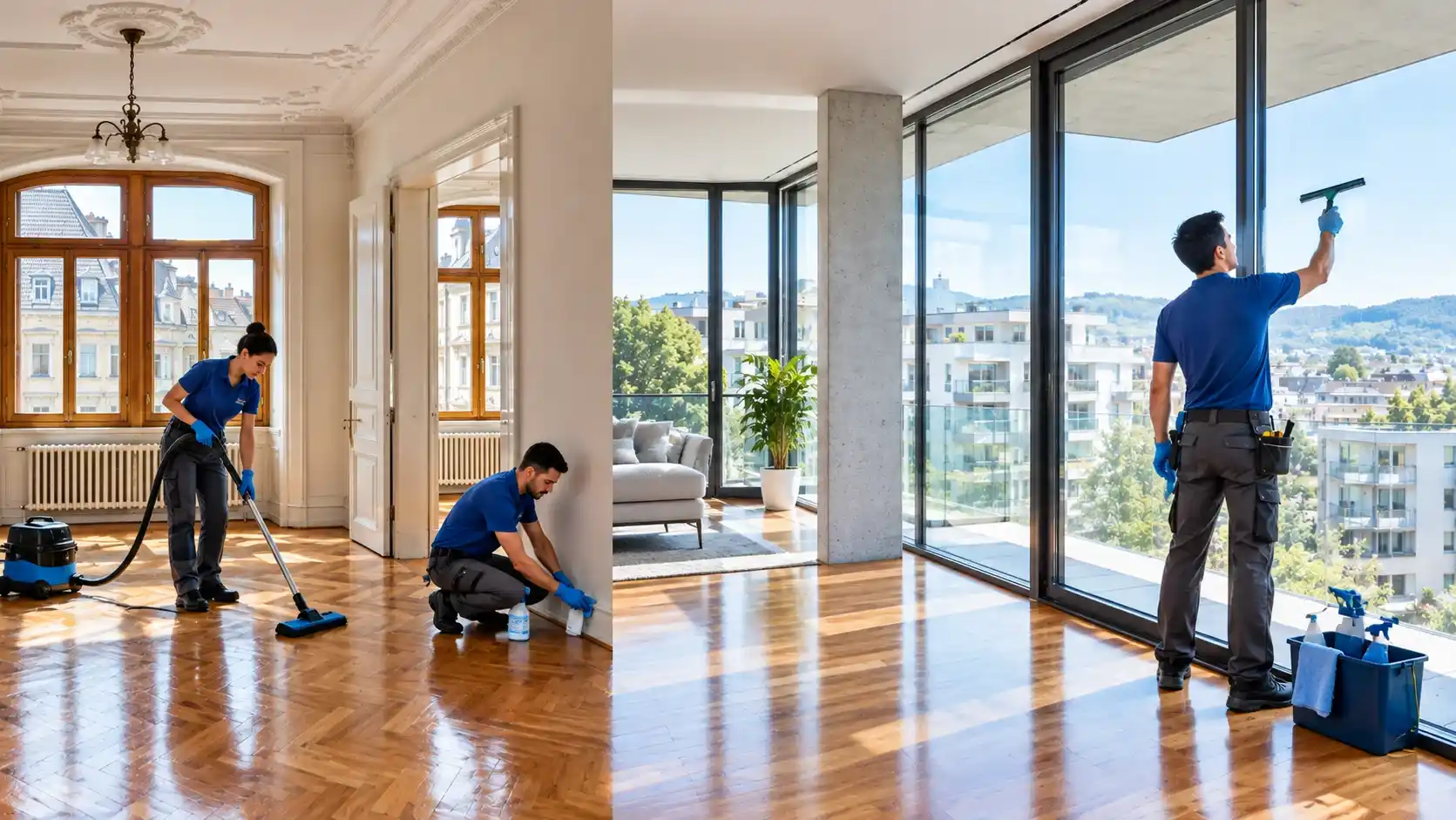
• Window cleaning — interior and exterior window cleaning for apartments and houses.
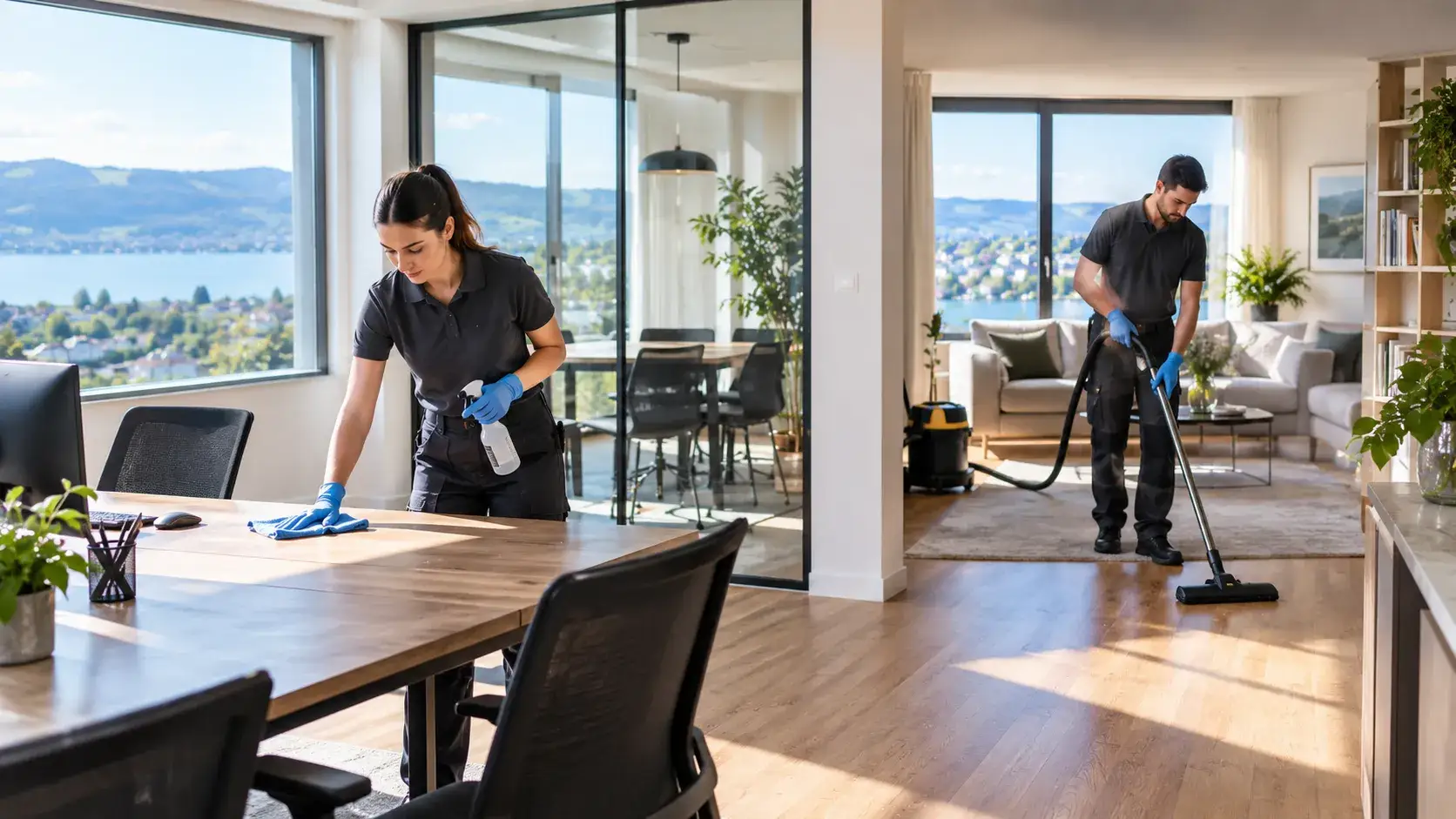
• Office cleaning in Zurich — regular commercial cleaning for businesses of all sizes.
Conclusion: Know the Rules Before You Hire
Hiring a cleaning lady in Zurich is entirely achievable — but it is not as simple as agreeing on a cash rate and a weekly schedule. Swiss employment law applies fully to household employers, and the obligations around AHV, accident insurance, employment contracts, and sick pay are real, enforced, and financially significant if ignored.
The two legitimate paths are clear: either follow the correct legal process for private hiring — which is manageable with the simplified AHV procedure and appropriate insurance — or book through a professional cleaning agency and have zero employer obligations from the start.
Züriclean provides professional regular cleaning services throughout Zurich with full legal compliance, trained staff, replacement cover, and eco-friendly products — so your home is clean, and you stay completely on the right side of Swiss law. Visit zuericlean.com to request a quote today.
Frequently Asked Questions: Hiring a Cleaning Lady in Zurich
1. Do I legally have to pay AHV for a private cleaning lady in Zurich?
Yes, if she is your employee and not independently self-employed. Under Swiss law, all employers — including private households — must pay AHV contributions for domestic workers. The simplified settlement procedure (Vereinfachtes Abrechnungsverfahren) makes this straightforward: a flat 10% of gross wages, reported once a year. Failure to comply can result in back-payments, interest, and penalties from the SVA Zürich.
2. What happens if my cleaning lady gets injured at my home and I have no accident insurance?
If your domestic worker is injured at your property and you have not provided the mandatory accident insurance required under the UVG, you are personally liable as the employer. This can include medical costs, rehabilitation expenses, and compensation for lost earnings. Swiss courts consistently enforce this liability. Even for a cleaner working just a few hours per week, accident insurance must be in place before she starts work.
3. Is there a simpler way to hire a cleaning lady in Zurich without all these obligations?
Yes. Booking through a professional cleaning agency like Züriclean eliminates all employer obligations. The agency is the employer. You have no AHV, no accident insurance requirement, no employment contract, and no sick pay liability. The total cost is often comparable to private hiring once all legal obligations are properly costed.
4. Can I hire a cleaning lady as self-employed to avoid AHV obligations?
Only if she is genuinely self-employed — meaning she works for multiple clients, sets her own rates and methods, brings her own equipment, and is registered as self-employed with the AHV compensation fund. If she works primarily for you and you control her working conditions, Swiss authorities will classify her as your employee regardless of any informal 'self-employed' label. The risk of misclassification falls entirely on you as the household employer.
5. What is the minimum wage for a cleaning lady in Zurich?
Zurich has a cantonal minimum wage. Since 2024, the minimum gross hourly wage in the Canton of Zurich is CHF 23.90. For domestic workers, this applies regardless of whether they are employed directly or through an agency. Most professional cleaning agencies charge between CHF 30 and CHF 45 per hour as the all-inclusive service rate, which covers wages, social insurance, insurance, and overhead.

.webp)




.webp)


.webp)


_11zon.webp)


.webp)


